Saturday, December 28, 2019

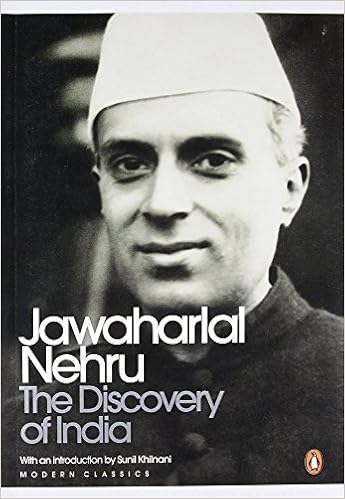
Book review- Discovery of India

Image result for discovery of india
An awesome book that traces all of Indian history from pre-historic times to 1944 when the book was written. As Nehru puts it, the intent of the book is to establish the integrity of the Indian past, history independent of British renditions and make people of India proud of their heritage. Nehru wrote this book while in jail with little access to journals and other books and so this is mostly a work of his learnings from explorations across the country. I am not sure how many of present day politicians possess that understanding of Indian culture and have a vision for future as expressed by Nehru in 600+ pages book.

While book presents interesting bits for anyone who wants to understand our culture and heritage, here are some of them –
  1. Our origins in form of Indus valley civilization was more advanced (stemming from city planning, houses, trade and law) than similar civilizations elsewhere but probably didn’t get noticed because European researchers who came up studying in 18th century focused more on the later (the Greek, Roman etc.)
  2. Our civilization has been based on security and stability via joint family etc. and that makes it successful than any other in West. Indian philosophy is “individualistic under a social structure” which means perfect freedom to think and believe what one liked while adhering to the social norms
  3. While there are many theories of how caste came into being but one theory relates to Aryan conquest of India. Instead of terminating or enslaving the entire population, as was the norm those days, they created a caste system assigning lower caste to people here and upper caste for themselves. While the system had its own shortcomings, caste system allowed people from new conquests to be merged into respective castes.
  4. Coming on to Akbar, Nehru says while he was a great ruler, what surprised him was his lack of sea knowledge, no focus on scientific research, no training of people abroad, and no book printing. This legacy carried forward by later Mughal rulers was exploited by Europeans to bring in their rule in India
  5. An interesting take on why we find certain skills confined to certain religions only. The reason for this is that religions conversion those days were group conversion and not individual conversions and hence the entire village (the villages in those times being organized around skills) would convert
  6. Rise of British is attributed to multiple reasons including conquest of Bengal which gave them enough money to proceed to other regions and then keep adding, possible fluke as individually each of the Sikhs, Marathas, Tipu had defeated them but never together, infighting amongst Indian states and finally fall of Mughal Empire and disintegration of country into smaller states
  7. With British rule, for first time, center of gravity fell outside India and with people who felt that they were superior and that the ‘new’ people didn't want to Indianize.
  8. All talk of great infra development and running of government during British raj came at significant cost. For example, the railway was guaranteed by government of India at 5% return on capital invested
  9. 1857 revolt was essentially a feudal outburst and it was only in 1900s that the real struggle from masses began to oust British

Tuesday, December 3, 2019

Book review- Good Strategy Bad Strategy


A good book to understand good and bad strategy with real life case studies from different companies. One-line summary - good strategy is not about some vision statement but set of coherent actions to tackle one or two identified critical issues. One example that stuck me was case of silver machine that churns silver coins is an advantage but not an competitive advantage. The former is more like a bond. An competitive advantage would accrue when either machine can be engineered to increase output or market be manipulated to increase demand.

Monday, July 15, 2019

Book review- 48 Laws of Power


Wonderful book - Being powerful is an exaggeration but in this world where we socialize with so many people at office and at work, it does help to deal better with everyone. If I would want to pick a few rules, I would say - Never outshine your master, Never get into argument, when asking for help appeal to self-interest, make your accomplishment seem effortless, think as you like but behave like others, despise free lunch, never reform too much at once, assume formlessness. 

I also enjoyed sharing some of the stories with my young son too.

Tuesday, September 4, 2018

Power User Curve over MAU/DAU for understanding users

Anyone in product development understand the importance of power users as they are the ones that drive successful companies. 

Traditionally, we use DAUs and MAUs to measure engagement. However, they do not measure power users. Introducing Power User Curve, which is histogram of users’ engagement by the total number of days they were active in a month/week depending on your business. You can measure engagement as app logins or for specific features which are relevant to your business. 

The advantage with Power User Curve is that it shows the variability among your users: some are slightly engaged. When mapped to cohorts, Power User Curves let you see if your engagement is getting better over time. Data for different features can help us decipher and make more informed decissions. 

Read the article in detail here - https://andrewchen.co/power-user-curve/ 


Sunday, September 2, 2018

This is How Google will Collapse

This is an interesting article on reasons leading to possible collapse of Google empire which has been traditionally been built on ads. 

  • Shift in user trends from search to discovery
  • Lesser ads being delivered because of blocking ads features on devices esp iPhone 
  • Lack of trust amongst users in banner ads
  • Over-reliance on screen ads and missing disruptive trend of voice based search

Read details here- https://hackernoon.com/how-google-collapsed-b6ffa82198ee

Tuesday, August 21, 2018

How Duolingo Built a $700 Million Company Without Charging Users

https://producthabits.com/duolingo-built-700-million-company-without-charging-users/

This is a good article on how Duolingo disrupted the language learning industry and became a $700 Million company in 9 years.

Duolingo provides free app to learn a language. Currently, they have over 25 million monthly active users learning a language each at their own pace.

The company started in 2009 tapping into hundreds of millions of people who wanted to learn a new language but couldn’t afford to shell out a ton of money for expensive software. Duolingo’s early monetization plan was to charge businesses for the content that users translated as a byproduct of studying a language.

From 2009-12, Duolingo didn’t actually partner with companies to build out the B2B translation service, but they designed their app to increase number of users and engagement. Besides web app, Duolingo created a mobile app which used pictures, video clips, and the phone’s microphone to help users learn words, write, and speak.

In 2013, for the first time, Duolingo announced partnerships with BuzzFeed and CNN. With crowdsourced translations, their effective translation cost was around 4 cents per word, compared to translation industry's average price of around 6 to 10 cents per word.

However, Duolingo realized that expanding their B2B services was going to require a more enterprise sales-driven model—which meant potentially less attention on the product and the users. So, in 2014, Duolingo deprioritized B2B translation service and instead released a testing certification service for a small fee.

In 2015 and 2016, Duolingo launched program for Schools and flashcards both of which helped improve engagement significantly.

In 2017, Duolingo started serving ads to users. It also released a subscription plan that removes ads and lets users download lessons for offline use.

Duolingo has raised $108 Million in funding in over 5 rounds with current valuation at about $700 Million.

Monday, August 13, 2018

Book review - Design Of Everyday Things by Don Norman

"Design Of Everyday Things" by Don Norman is a book that not only shares principles of good design but also evaluates those from perspective of human psychology.

Book starts from design principles including making things discoverable, understandable and making it more delightful for users.

It then delves into difference between human and machines and who is good in what. Basically, human strength is being creative, flexible and imaginative while machines are good in being precise and acurate.

It then talks about how humans can interpret precise behavior from imprecise knowledge in the head and in world and that's something that even AI cannot do.

Finally, it talks about errors and how can they be classified as slips and mistakes. It further classifies them and talks about how to use design principles to avoid them.

Overall a must read for everyone interested in solving customer needs.